Crochet Shawl Tutorial for Beginners With Simple Steps
Explore Crochet Shawl patterns, yarn, and tools for beginners. Follow simple steps and helpful tips to create a cozy wrap you’ll love wearing or gifting.
Table of Contents
A first crochet shawl project can become a wearable wrap one repeated row at a time. Could a few familiar stitches really make something you’ll reach for often? Yes: even a simple stitch repeat can create a comfortable layer you can wear or give. You do not need to know every crochet technique before you begin.
A turning chain is the chain or chains worked at the start of a row to bring the yarn to working height, with its stitch-count role determined by the pattern. That small detail can affect where you place the first stitch, so it helps to understand it early.
This tutorial helps you choose a pattern that suits your level, gather the yarn and tools it calls for, and follow the repeat. You’ll also learn how to finish and shape the fabric so your finished wrap looks cared for. Start with a simple pattern, take the rows one at a time, and check your stitch count as you go. Choose a pattern whose first few rows feel manageable, then gather only the tools it calls for.
Which Crochet Shawl Shape Should You Choose?
If you want a familiar shape that covers the back, start by considering a triangle. Triangles are a traditional across-the-back option, while crescents curve over the shoulders and rectangular stoles grow through a repeated row.
Your preferred way to wear a shawl can guide the choice. A triangle gives you a pointed end to knot or tuck, a crescent follows the shoulders, and a stole can sit like a scarf.
| Shape | How it sits or grows | Wearing option | Advantage or trade-off |
|---|---|---|---|
| Triangle | Spreads across the back | Knot at the front | Traditional coverage, pointed ends |
| Crescent | Curves along the shoulders | Drape over both shoulders | Stays put without pinning |
| Rectangular stole | Grows through a repeated row | Wear scarf-style or belted | Simple length-based growth |
For shawl crochet, the triangle offers the most familiar outline, but its ends may need arranging when you move. Crescents follow the shoulders and stay put without pinning, which can make them easy to wear during the day. A rectangular stole is a wrap with a straightforward row repeat; you choose its length as you work.
A scarf-like stole can also be folded or belted, so it suits more than one outfit. Choose a crescent when keeping the wrap on your shoulders without a pin matters most.
How Do You Choose a Beginner-Friendly Pattern?
A pattern whose repeat makes sense by the third row is a useful first-project signal. Choose one with clear instructions and a short row you can recognize without rereading every line.
A simple pattern still teaches useful skills. You can practice counting, turning, and finding the first and last stitches without juggling a long list of new stitches.
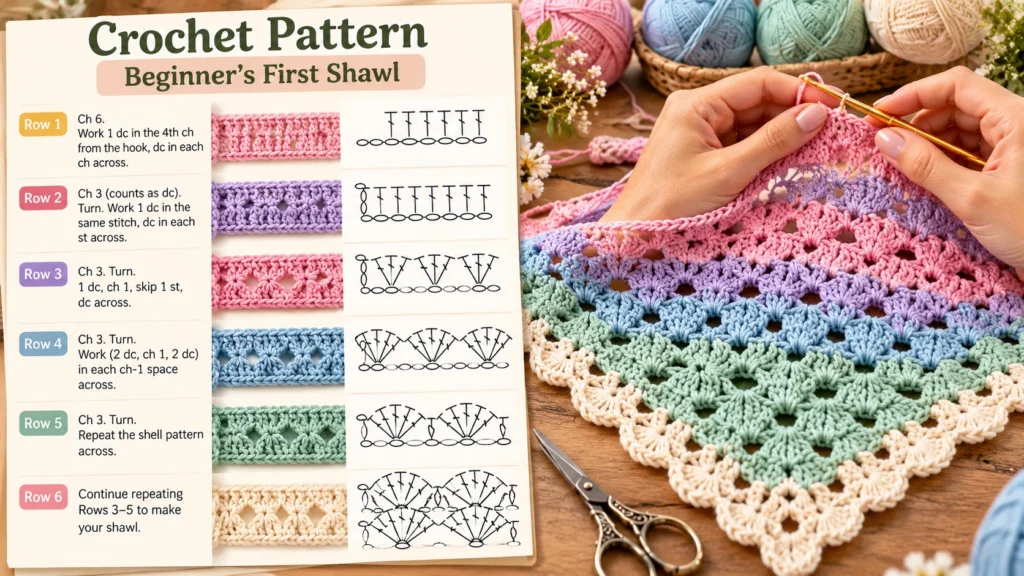
Look for a repeat you can learn quickly
Predictable edge and center increases make a triangle pattern easier to track. If each row adds stitches in familiar places, you can spot a missing increase before it changes the whole shape.
Look for a short, repeatable row. Beginner-friendly choices include triangle patterns worked in trebles and chain spaces, or mesh made with double crochet and chain stitches. Chain spaces are the gaps formed by chain stitches. Once you learn the repeat, the growing fabric shows where the next stitch group belongs.
Before you start, make this three-item pattern check:
- Read the skill note and make sure its level suits you.
- Scan the stitch list for unfamiliar abbreviations or stitches.
- Check whether the repeat is written out or shown in a chart.
Save charted lace for a later project
Fine lace patterns often use charted repeats, which take patience, good light, and careful place-keeping. Filet lace, shell and fan stitches, and simple pineapple motifs can offer decorative detail without the same dense chart work.
A chart can be satisfying once you know how to read its symbols. For a first shawl, you may prefer written row instructions or a pattern that explains each chart symbol. If you try fine lace, thread a lifeline through every few rows. A lifeline is a spare strand passed through stitches, giving you a safe row to return to if you need to undo work.
Before starting a fine lace design, make sure you are comfortable following its chart and keeping your place.
What Yarn and Hook Should You Use?
For a light lace wrap, choose fingering- or sport-weight yarn rather than a dense, heavy fabric. DK weight gives you more structure while staying breathable and drapey. Worsted weight is the thickest choice recommended here for a warm-weather shawl, and open stitches can keep it from feeling too heavy.
The weight changes the fabric as well as the look. A finer yarn makes a delicate layer, while DK creates a more substantial everyday wrap. If you choose worsted for warmer weather, lacy stitches leave more space between yarn strands.
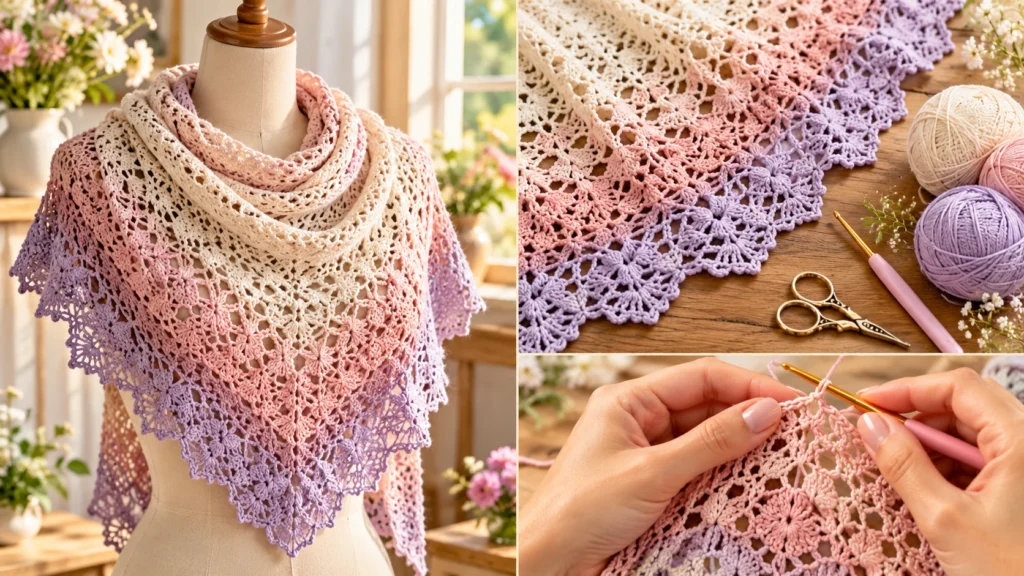
Match yarn weight to the fabric you want
For delicate lace, fingering- and sport-weight yarns are common choices. DK yarn balances structure with drape, so it can suit a wrap you plan to wear often. Worsted yarn makes a thicker fabric; use lacy stitches when you want a warm-weather shawl with more airflow.
Check fiber and hook size before starting
Wool and wool blends hold their shape during blocking. Silk, bamboo, and merino-silk blends drape fluidly but may grow lengthwise. Cotton and linen soften with washing, so the finished feel can change after care.
Hook size also affects the fabric. Lace and 4-ply yarn commonly use a 3-4 mm hook, DK a 4-5 mm hook, and Aran or chunky a 6-8 mm hook. Treat those ranges as starting points, not fixed rules.
The Double Crochet All The Way Shawl calls for a 4 mm (US G/6) hook and a gauge of 16 double crochet stitches and 10 rows per 10 cm / 4 inches. Its pattern says gauge is not essential because a different gauge will still fit that shawl. Use the yarn label’s hook recommendation first, then adjust for the fabric you want.
If you want a looser fabric, try a hook 1-2 sizes above the size listed on the yarn label.
How Much Yarn Does a Crochet Shawl Need?
Plan on roughly 400-600 yards for a small, scarf-like shawl. A medium shawl generally takes 600-800 yards, while a large, oversized wrap can use 900-1200 yards.
These ranges help you plan a purchase, but they do not replace the yardage listed for a particular pattern. A wide triangle and a long stole use different amounts, even when both count as medium pieces.
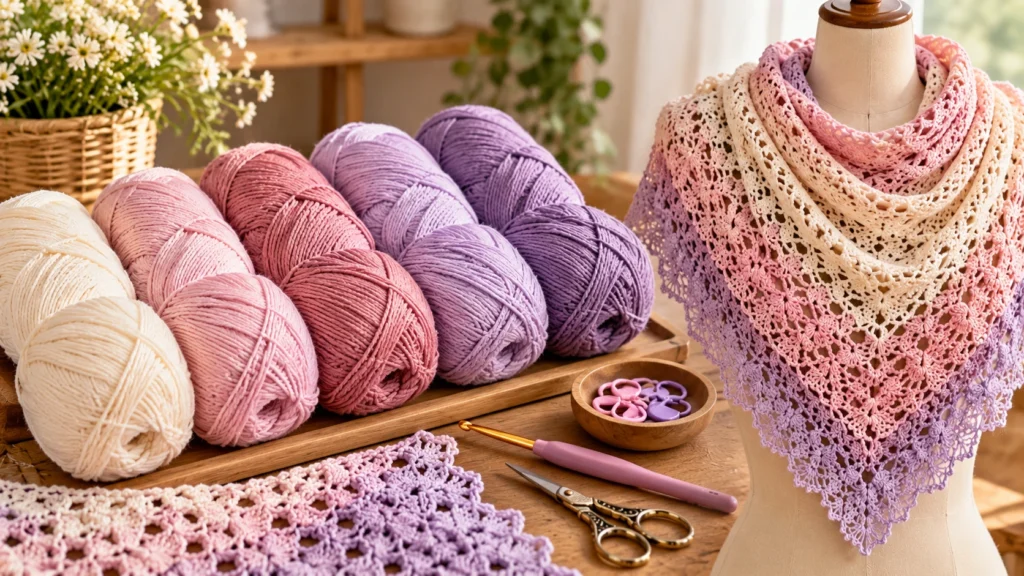
| Finished size | General yarn estimate in yards | Example description |
|---|---|---|
| Small | 400-600 yards | Scarf-like shawl |
| Medium | 600-800 yards | Everyday shoulder wrap |
| Large | 900-1200 yards | Oversized shawl |
Metric estimates are also useful when you shop for yarn listed in meters. An adult triangle in lace or 4-ply commonly takes about 400-800 m. A DK everyday wrap commonly takes about 500-700 m.
The estimates depend on yarn weight and finished dimensions. A larger wrap needs more yarn, and a heavier yarn can use yardage differently from a fine yarn. Check the pattern’s stated amount for the size you plan to make, then compare it with the label on each skein.
Check the pattern’s own yardage before buying, especially if you plan to make an oversized version.
Which Tools and Abbreviations Make the First Rows Easier?
You can start most shawls with a hook, a tapestry needle, and a way to mark important stitches. A few small tools make it easier to follow a pattern and finish the edges neatly.
A basic setup does not require a large kit. Add blocking supplies only if you plan to shape the finished fabric flat.
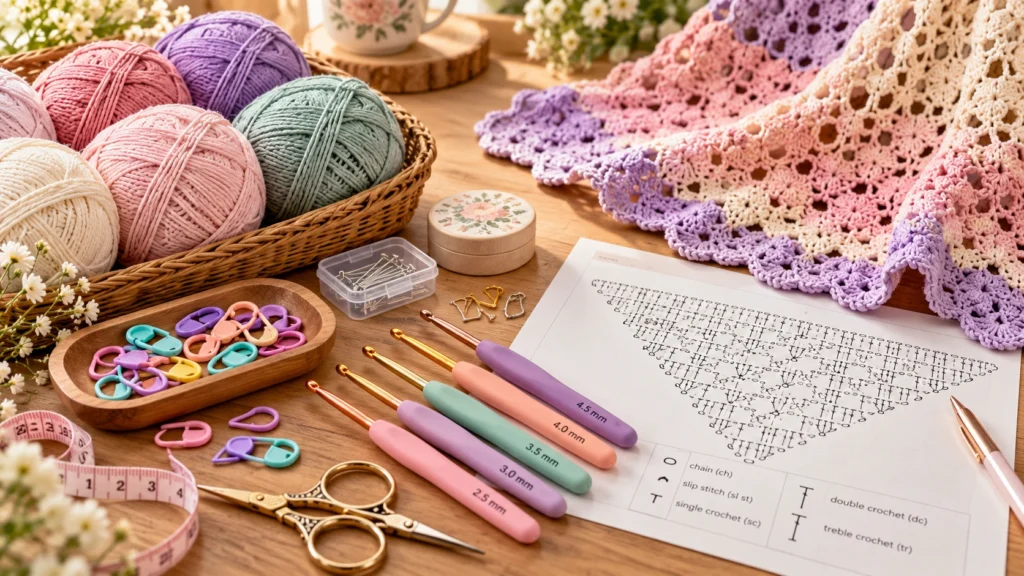
- Hook: use the size named in your pattern as your starting point.
- Tapestry needle: weave in yarn ends with its blunt tip.
- Stitch markers: mark a center space, edge, or key increase.
- Row counter: track the repeat without relying on memory.
- Blocking pins or mat: hold the shawl in shape as it dries.
Patterns use short forms to keep row instructions compact. In U.S. crochet terminology, ch means chain stitch, dc means double crochet, st means stitch, inc means increase, and dec means decrease. Dc2tog means double crochet two stitches together; sl st means slip stitch.
Other common forms include sc for single crochet, hdc for half double crochet, and yo for yarn over. Tch or t-ch means turning chain. These abbreviations are useful only when you follow the pattern’s stated terms, since crochet abbreviations can differ between countries.
The turning chain may or may not count as a stitch. For example, when making double crochet into a starting chain, skipping to the fourth chain from the hook gives a stitch count equal to the chain count minus 2. Skipping to the third chain gives a count equal to the chain count minus 1. Those are examples of counting, not universal instructions to skip chains.
When a pattern says the chain-2 does not count as a stitch, its half-double-crochet starting-chain count is the chain count minus 2. Follow the pattern’s stated stitch-count convention, since a turning chain does not count the same way in every design.
How Do You Start a Top-Down Triangle Shawl?
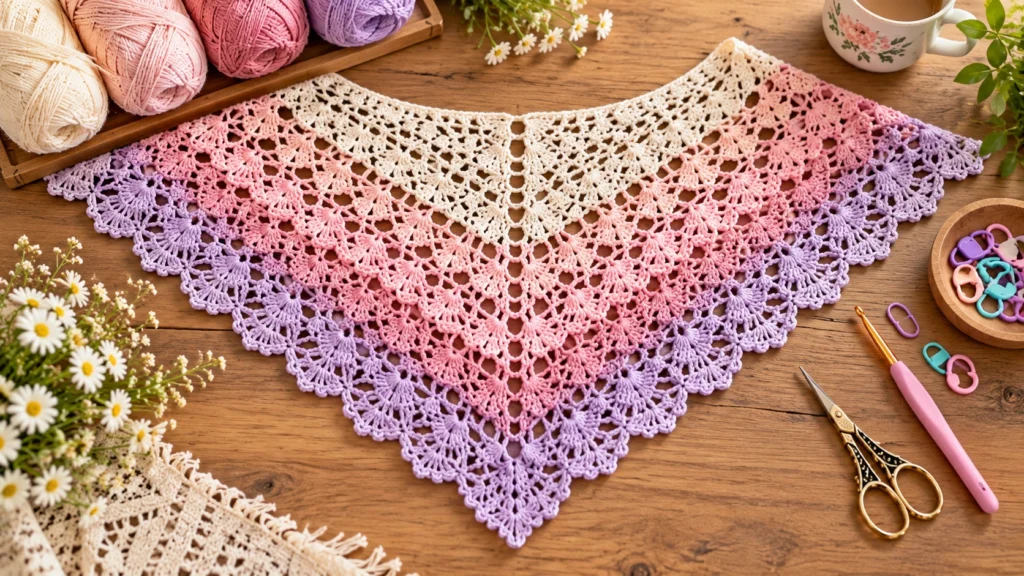
A top-down triangle starts at its center and grows outward through a repeating increase row. You can begin with a magic ring or join chain 4 into a ring, depending on the pattern.
The center chain space forms the point between the triangle’s two sides. Keep it easy to see as your rows grow.
Make the center ring and first row
A magic ring gives you an adjustable center. A joined chain-4 ring is another common start. Follow the pattern’s choice, since the first row is worked into that center opening.
Repeat the center increase
One common version uses these steps. Its chain-3 start counts as a double crochet; another pattern may use a different turning-chain rule.
- Make a magic ring, or chain 4 and join with a slip stitch to form a ring.
- Row 1: chain 3, work 2 double crochet in the ring, chain 2, then work 3 double crochet in the ring. Turn.
- Row 2: work 2 double crochet in the first stitch, then (2 double crochet, chain 2, 2 double crochet) in the center chain-2 space.
- Finish Row 2 with 3 double crochet in the last stitch. Turn and repeat the row until the shawl reaches your preferred size.
The repeated row adds stitches at both edges and in the center chain-2 space. That center group creates the point, while the edge stitches widen the two sides. Keep the increase locations consistent so the triangle stays balanced.
The Double Crochet All The Way Shawl uses a different starting setup: chain 4 joined with a slip stitch to close the round. It is worked top-down, with a turn at the end of every row. The first 3 chains at each row start count as 1 double crochet, and the last stitches go into the third chain of the previous row. That chain-4 joined start is specific to that pattern, not a rule for every triangle.
Turn after each row and check that the center chain-2 space remains easy to identify.
How Do Bottom-Up and Tip-to-Tip Shawls Differ?
A bottom-up triangle begins at a point, while a tip-to-tip shawl grows along one side before reversing. The row direction and the place where growth changes determine how each shape develops.
In a bottom-up pattern, the first stitches sit at the point. Repeated increases widen the fabric toward its top edge.
Build a bottom-up triangle from its point
A common bottom-up start uses chain 4, then 2 double crochet in the first chain. That makes 3 stitches for the first row. Each repeated row begins with chain 3 and 2 double crochet in the first stitch, then ends with 3 double crochet in the last stitch.
The repeated edge groups increase the row at both ends. Follow the pattern’s turning-chain rule and stitch count, especially when you reach the last stitch. A missed edge group can make one side grow differently from the other.
Grow to a center row, then decrease
A tip-to-tip shawl increases on one side of each row until it reaches the center row. It then decreases on that same side. The center row determines the shawl’s height, so the increase phase controls how tall the finished piece becomes.
In one tip-to-tip setup, chain 4 counts as the first double crochet and as a chain-one base. The pattern repeats two increase rows until the chosen center row, then repeats two decrease rows until 2 stitches remain. That chain-4 role belongs to this setup, not every shawl pattern.
As the rows grow, keep track of which side holds the increases. The decrease rows should reverse that same edge rather than create a second shaping line. Mark the center row in a tip-to-tip pattern, since that row sets the shawl’s height.
How Do You Adjust a Shawl’s Size and Shape?
To change a triangle’s dimensions safely, keep its increases in the places the pattern specifies. Edge increases widen the sides, while a middle increase can create the center corner.
Adding or removing stitches at random can shift that corner or distort one edge. Make adjustments by continuing or stopping the stated repeat, rather than changing where each increase belongs.
Keep the increase points consistent
A triangle pattern may place increases at both edges and once in the middle. The center increase forms the corner; edge increases extend the sides. When you add rows to make the shawl larger, preserve all three increase points in every repeat.
For a different shape or length, use the pattern’s repeat as your guide. Stop when the fabric reaches the dimensions you want, if the pattern allows that choice. Keep notes about the row where you stop so both sides remain balanced.
Count stitches where the pattern defines them
Compare your stitch count with the number given at the end of the row. Count in the same way as the pattern, including or excluding a turning chain according to its rule. A mismatch may come from a missed edge stitch, a skipped center increase, or counting the turning chain incorrectly.
Gauge helps you judge how your stitches and rows compare with the pattern’s fabric. The Double Crochet All The Way Shawl lists 16 double crochet stitches and 10 rows per 10 cm / 4 inches, but says gauge is not essential because a different gauge will still fit that shawl.
That note applies to that design, not every pattern. A swatch can still show whether your fabric feels too firm or open and help you estimate how your yarn behaves. If your stitch count is off, check the turning-chain rule before adding or removing stitches.
How Do You Finish and Block a Shawl?
Blocking can open up lacy stitches and make the finished fabric easier to shape. Wet blocking sets the fabric while it dries, helping the edges lie in the outline you want.
Handle wet yarn gently, especially when the stitches are open. Stretch the shawl gradually rather than pulling hard on one edge.
Wet-block the fabric into shape
Use these steps to wet-block a finished shawl:
- Soak the shawl in lukewarm water.
- Lay it flat on blocking mats and gently press out excess water with a towel.
- Stretch the fabric gently into the shape you want.
- Pin the edges with T-pins, adjusting the outline as you go.
- Let the shawl air-dry completely before removing the pins.
Blocking can open stitches in a lacy shawl, making its spaces easier to see. A towel helps squeeze out excess water before pinning, but avoid twisting the fabric. Once pinned, let the whole piece dry before you unpin it.
Choose care that suits the fiber
Steam blocking is an option for cotton or linen shawls. Check the yarn and pattern care guidance before applying heat. For a wool shawl, hand-wash in cool water with wool wash, roll it in a towel, then dry it flat.
When you dry lace, pin it back into shape and leave it in place until the fabric is dry. Superwash and acrylic wraps can go in a machine on a wool cycle. Care needs vary by fiber, so use the yarn label and pattern instructions to guide washing.
Unpinning while the shawl is still damp can undo the shaping. Leave the pinned shawl in place until it is completely dry before removing the T-pins.
Where Can You Find a Pattern That Fits Your First Project?
A pattern listing is easier to assess when you check its construction, skill cue, and yarn requirement together. The designer’s notes can also tell you whether the project uses separate pieces or a particular stitch motif.
Listings may include both crochet patterns and knit or knitting patterns. Check the craft label before you start, then compare the named yarn with what you plan to use.
| Pattern | Skill or construction cue | Yarn detail |
|---|---|---|
| Oversized Style | Easy level, Toni Lipsey | Red Heart Roll With It Tweed |
| Classy Pentagon | Three separate pieces, Ellen Gormley | Red Heart Unforgettable |
| Blissful Moment | Beginner-friendly, Corina Gray | Red Heart Super Saver |
| Sidewalk | Slightly harder pineapple stitch, Kimberly K. McAlindin | 6 balls of Red Heart Soft |
| Buttoned Shawl | Susan Heyn | Red Heart With Love or another worsted-weight yarn |
These examples show different ways designers describe a project. A clear skill cue can tell you whether the pattern is aimed at beginners, while a construction note gives you a sense of how the piece comes together. Shells & Clusters is another named option made with Caron Skinny Cake.
When you shop, check that the listing says crochet if you want a crochet project. Knit and knitting patterns use different instructions, even when the finished piece is also called a shawl. Check the craft and skill labels before starting, and read the material requirements closely.
Before buying yarn, confirm that your chosen pattern’s listed materials match the yarn you plan to use.
How Can You Wear or Gift a Finished Shawl?
A shawl can be worn as a wrap, a scarf, or a shoulder layer, depending on its shape. A triangle can be knotted at the front or worn under a coat, while a crescent can rest across the shoulders.
A stole gives you another simple option: wear it scarf-style or add a belt to hold it in place. These styling choices let the same piece work with different outfits.
For a crescent, a shawl pin can hold the fabric at one shoulder. A triangle’s pointed ends make it easy to knot in front or tuck under outerwear. A long stole can be folded around your neck like a scarf, or belted over a top.
A shawl can make a practical gift when you do not know someone’s measurements. Unlike a fitted garment, it does not need a precise body measurement to fit. You can choose a shape that works with the recipient’s usual outfits and a yarn suited to their climate.
Think about how the person dresses before choosing the pattern. A stole may suit someone who often wears scarves, while a crescent can be convenient for someone who likes a shoulder layer. A triangle offers another familiar shape, with ends that can be styled in more than one way.
For a gift, choose a shape the recipient can wear in more than one way.
Conclusion
Your first shawl can be simple: choose a shape you like and a repeat you can follow. A pattern that matches your skill makes the project easier to manage, row by row. You can take your time with the first stitches and check the pattern’s count before moving on.
A clear repeat also makes it easier to notice when an edge or center stitch is missing. Trust the pattern’s instructions for its turning chain and increases, rather than assuming every shawl uses the same setup.
Pick one beginner-friendly pattern today, gather its listed materials, and work the first row.
FAQ
Can I use a different yarn weight than the pattern calls for?
Yes, you can use a different yarn weight, but the drape and finished size may change. A thicker yarn usually makes a more substantial fabric, while a finer yarn can create a lighter wrap. Start with the hook size on the yarn label, then consider going up 1-2 sizes for a looser fabric. Check your stitch count as you work.
Do I need to make a gauge swatch for a shawl?
A gauge swatch helps you judge the fabric and how much yarn your stitches may use. It can show whether your fabric feels too tight or loose before you make many rows. The Double Crochet All The Way Shawl says gauge is not essential because a different gauge will still fit that shawl. Other patterns may rely more closely on gauge.
What does ch 3 mean in a crochet pattern?
Ch 3 means to make three chain stitches. At the start of a row, those chains may serve as a turning chain, but whether they count as a stitch depends on the pattern. The Double Crochet All The Way Shawl counts its first 3 chains as 1 double crochet. Check the pattern’s stitch-count notes before placing the next stitch.
How do I count double crochet stitches made into a starting chain?
The count depends on which chain you skip to and the pattern’s instructions. Skipping to the fourth chain from the hook gives a stitch count equal to the chain count minus 2. Skipping to the third chain gives a count equal to the chain count minus 1. Use those counts only when they match the pattern’s starting-chain method.
Can I stop crocheting a top-down shawl when it is large enough?
Yes, you can stop a top-down triangle when it reaches your preferred size, as long as the pattern allows you to end the repeat there. Each repeated increase row makes the shawl larger. Check the piece on your shoulders as it grows, and note the row where you stop so you can finish consistently.
Can I steam-block a cotton or linen shawl?
Yes, steam blocking is an option for cotton or linen. Check the yarn label and pattern care guidance before applying heat, since fibers and yarn finishes can react differently. Work carefully, and do not press the iron directly onto the stitches unless the care instructions allow it. Let the shawl dry fully in its intended shape.