Easy Crochet Angel: 12 Beginner Patterns I Can Make
Explore 12 easy crochet angel patterns I can make, with beginner-friendly ideas and clear inspiration for creating charming handmade decorations at home.
Table of Contents
Would a small handmade decoration make your home feel more personal, if the project stayed manageable? I like crochet angels for that reason: they can become keepsakes, holiday decorations, or gifts, depending on the design.
Amigurumi is a crochet technique for making small figures, often worked in rounds or spirals. Some designs suit a first project, while others ask for more shaping or finishing. I look for a pattern that fits its purpose, whether I want something to hang, display, or give away.
The options range from small figures to seasonal ornaments and larger display pieces. I’ll help you judge what feels realistic before you begin, so your first choice matches your skills and your plans. A few practical checks make it easier to spot a pattern that fits a beginner.
What Makes an Angel Pattern Beginner-Friendly?
A beginner-friendly design has construction, instructions, and finishing demands that match the crocheter’s current skills. I judge crochet angel patterns by how clearly they explain each step, not by the finished picture alone.
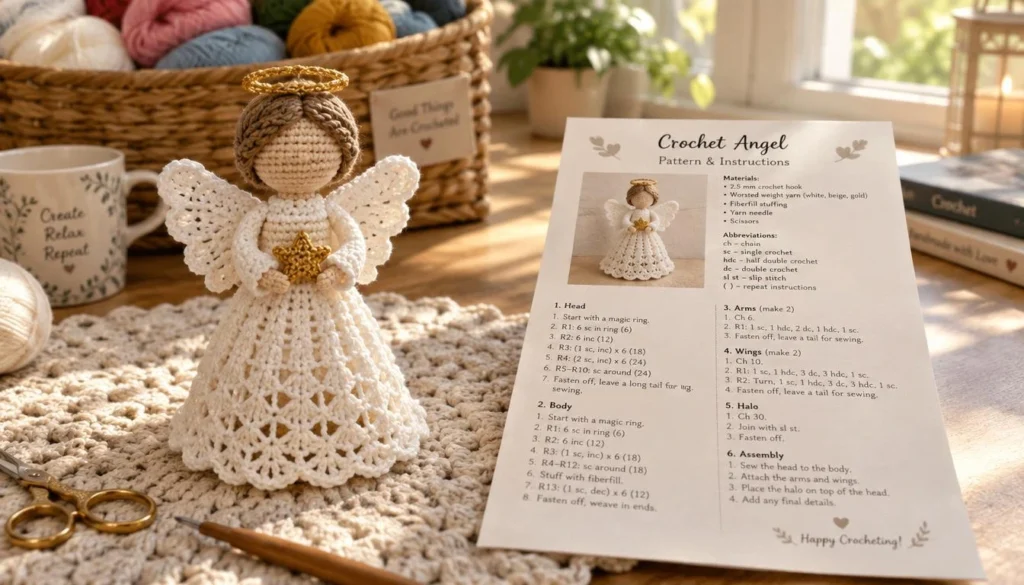
Before I settle on an angel pattern, I check four things:
- Clearly written steps that explain the pattern’s stitches and sequence.
- Manageable shaping, without too many unfamiliar changes at once.
- A finished size and intended display that suit my project.
- Photo or video help for parts that may be hard to picture.
The phrase easy crochet angel for beginners is a useful way to think about skill fit. It does not mean every design uses the same stitches or construction. One pattern might be worked in rounds, while another might use separate pieces that need sewing together.
I avoid choosing by a cute finished photo alone. A lovely face or skirt does not show how many pieces need joining, whether the wings need shaping, or how much finishing follows. If the instructions feel unclear, the final assembly can take longer than the crochet itself.
Reading the construction notes first helps me estimate the work more realistically. A small angel can still involve detailed finishing, while a larger shape may use simple steps. Time and construction are useful ways to narrow down quick-project choices.
Easy Crochet Angel Patterns for Quick Projects
A quick project can still differ in construction and display use. I compare the stated time with the finished design, since a small ornament and a one-piece figure can feel quite different to make.
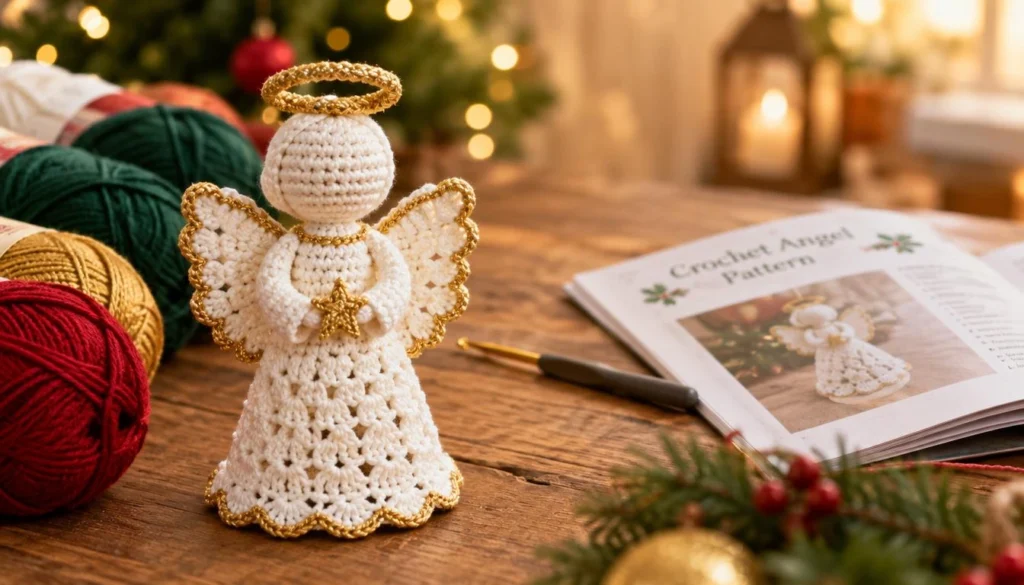
These three crochet angel patterns offer different ways to fit a project into a free afternoon or a short crafting session:
| Pattern | Stated project time | Concrete feature or use |
|---|---|---|
| The Littlest Crochet Angel | 15 minutes | Make multiples for tree decorations or gifts |
| Easy Angel Ornament | About an hour | A quick ornament project |
| Noelle | Under two hours | About 9 inches tall, worked top-down in one piece |
The Littlest Crochet Angel is described as a 15-minute project. Its small scale makes it practical for making multiples, either as Christmas tree decorations or as small gifts. A short stated time can make a design tempting, but it still helps to read the finishing instructions first.
The Easy Angel Ornament takes about an hour, making it another option when I want a quick crochet pattern. Its ornament focus makes its intended use clear. A free crochet project can be a good place to start, but I check the individual page for access details rather than assuming every pattern has the same terms.
Noelle is approximately 9 inches tall and takes under two hours. The pattern works from the head down to the skirt in one piece, and the angel stands on its own. That construction may appeal to someone who would rather avoid joining several separate parts.
These are stated times for these designs, not a guarantee for every crocheter. A first attempt may take longer while I learn the steps, and experience with the stitches can affect pace. Someone searching for easy crochet angel patterns for free can compare each project’s stated access and instructions before choosing.
Once time and construction narrow the field, finished size offers another practical filter. Smaller designs are easier to carry or hang, though compact size does not always mean simpler details.
Which Tiny Crochet Angels Suit Ornaments and Keepsakes?
A compact angel suits a reader who wants a decoration that takes up little space. These small crochet angels can work as keepsakes or accessories, but their finished size alone does not reveal how detailed the pattern feels.
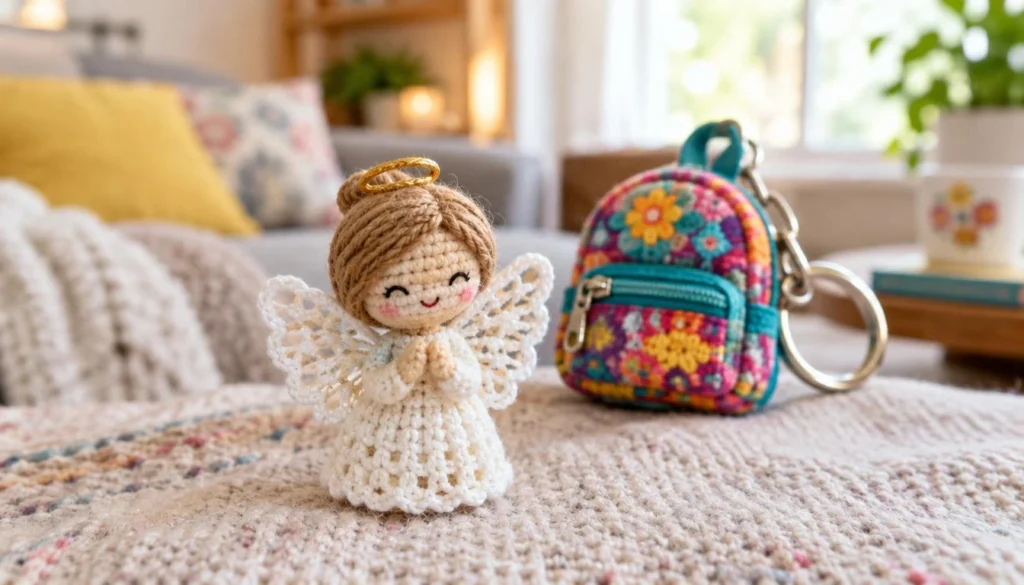
I compare the height with the intended use before choosing a tiny angel. The following patterns offer practical examples, from a car hanger to a small bag accessory:
| Pattern | Finished height | Practical use or help |
|---|---|---|
| My Little Angel | 7 cm | Car hanger or keychain |
| Little Angels Amigurumi | About 7.5 cm or 3 inches | Tree decoration and video tutorial |
| Amia the Guardian Angel | About 8 cm or 3 inches | Backpack accessory or keychain |
My Little Angel measures 7 cm tall and can be used as a car hanger or keychain. That scale may suit someone who wants to carry a small reminder, rather than set out a larger decoration. For a hanging use, I would pay attention to how the attachment connects to the figure.
Little Angels Amigurumi measures about 7.5 cm, or 3 inches, and includes a video tutorial. Its size can suit a small tree decoration, and video support may help a crocheter follow the sequence. Amigurumi gives the figure a shaped form, unlike a flat ornament made in rows or lace.
Amia the Guardian Angel is about 8 cm, or 3 inches. It can be attached to a backpack or used as a keychain. Those uses put more wear on a project than a shelf display, so secure attachment matters as much as the small size.
A tiny angel may still include close shaping, small pieces, or careful finishing. The scale can make details harder to handle, even when the finished object is light and portable. I check the instructions for attachment steps and detail before picking a pattern for daily use.
Compact keepsakes are useful when space is limited, but a seasonal display may call for a different shape. Christmas-focused patterns include ornaments as well as small figures designed to stand.
Which Christmas Angel Patterns Work as Tree Decorations?
Choosing a finishing decoration for a Christmas tree often means deciding between a hanging ornament and a figure that stands nearby. These Christmas angel patterns take different forms, so I check the intended display before starting.
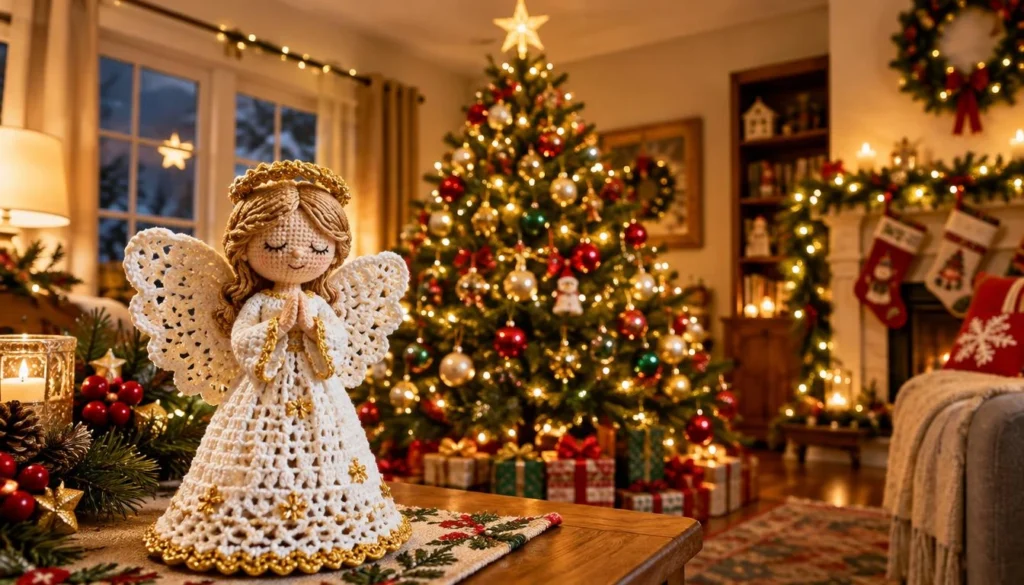
Three options offer distinct styles for seasonal decorating or gifting:
- Christmas Angel by Natalia Ruzanova is described as an easy amigurumi project for holiday decoration.
- Joy is approximately 5.75 inches, worked in continuous rounds, and has a double-layer skirt that helps it stand without stiffening. It includes a complete video tutorial.
- Elisa’s Little Angel is identified as a beginning-level project that can work as a Christmas gift or interior decoration.
The Christmas Angel by Natalia Ruzanova is described as an easy amigurumi project for holiday decoration. That makes it a direct option for someone seeking a seasonal crochet Christmas project. I still distinguish a decorative figure from an ornament designed to hang on a branch.
Joy measures approximately 5.75 inches and is worked in continuous rounds. Its double-layer skirt helps it stand without stiffening, and a complete video tutorial accompanies the design. A stand-alone base can be useful near a tree, though it does not automatically make the figure a hanging ornament.
Elisa’s Little Angel is identified as a beginning-level project. It can serve as a Christmas gift or an interior decoration. That flexibility may help if I want a holiday-themed present that remains on display after the tree comes down.
Before choosing an angel ornament, I check whether the pattern provides a hanging loop or describes a standing base. A design intended to stand is not necessarily a hanging ornament. The finished shape and the way it attaches to a branch affect whether it works on a tree.
Some Christmas designs work as tree decorations, while others suit a table or shelf. Readers who want a piece that stands on its own can compare the freestanding options by size and display role.
Which Angels Can Stand as Display Pieces?
For a shelf or mantel decoration, my first decision is whether the finished piece is designed to stand without added support. These crochet angel pattern options differ in height and display role.
The table compares three angels with stated standing details. Their dimensions describe these individual patterns, not a standard size for all angels.
| Pattern | Finished height | Standing or display detail |
|---|---|---|
| Francesca | 6 inches | Stands on its own with Wing Design 4 |
| Angelica | Approximately 9.5 inches | Stands on its own or works as a Christmas tree topper |
| Remembrance | Approximately 6.5 inches | Top-down, one-piece construction; stands without stiffening |
Francesca measures 6 inches and can stand on its own. The pattern uses Wing Design 4, a specific detail worth noting when comparing the design with other angel styles. Its stated standing feature suits a display spot where a hanging loop is not needed.
Angelica is approximately 9.5 inches tall and stands on its own. It can also be used as a Christmas tree topper, giving it a display role beyond a shelf or tabletop. I would consider the intended placement before starting, since a topper and a small shelf figure need different positions.
Remembrance measures approximately 6.5 inches and is worked top-down in one piece. Its construction allows it to stand without stiffening. A pattern that describes a stable base can be appealing if I want to avoid adding a support material during finishing.
Standing ability depends on the design’s shape and base, not just its height. I look for a clear statement about whether the angel stands unaided, particularly if the figure will sit where people may brush against it. The three listed sizes apply to their own designs alone.
A display piece solves one use, but angels also come in styles for different tastes and occasions. A delicate ornament, shaped amigurumi figure, or wearable wings can each suit a different plan.
What Other Angel Styles Can I Make?
I might choose a small figure for a keepsake, a delicate ornament for a window, or wings for a photo. Angel patterns cover all three looks, so I begin with how I want the finished piece to be used.
Changing the style changes the construction and the way the finished crochet fits into a home, gift, or event. A small shaped angel is only one way to make an angel-themed project.
What Can I Expect From Free Vintage Crochet Angel Patterns?
Readers looking for free vintage crochet angel patterns may encounter lace-like designs, thread work, or delicate ornament construction. Those features can create a lighter look than a small stuffed figure. I check the pattern’s instructions closely, since thread work and fine details may ask for careful handling.
Vintage-inspired styling is not the same as a verified vintage pattern. A modern design can borrow a delicate or classic look without being an older pattern. I use the description and instructions to understand the style, rather than treating the word “vintage” as proof of age.
How Do Amigurumi Angels Differ From Flat Decorations?
An amigurumi angel is a small shaped figure, often made in rounds or spirals. Flat or lace-style decorations use a different form, with less depth and a lighter outline. The choice changes how the finished project sits or hangs, even when both designs depict an angel.
A shaped angel amigurumi can work as a keepsake or a small gift. Its three-dimensional body gives it a figure-like appearance, while a flat decoration can fit a window or tree branch. I consider where the recipient might keep the piece before deciding which construction feels useful.
When Do Angel Wings Work as Wearable Photo Props?
Crochet wings and halos can work as photo props or costume accessories for an event. They offer an angel look without making a full figure. A child’s photo session, dress-up outfit, or themed portrait may call for wings that attach securely and sit comfortably.
Before making wearable wings for a specific person, I check the sizing and attachment instructions. A prop that looks right laid flat may sit differently when worn. The fit, attachment points, and wearer’s movement all matter for a piece intended for a photo or costume.
These styles ask for different shapes and finishing, so I choose a design that suits the occasion. Once I know the form I want, the next step is understanding the crochet skills and pattern supports that make the construction easier to follow.
What Crochet Skills Help With These Patterns?
I do not need to know every stitch before starting, but I should be ready to follow the stitches named in the crochet pattern. A beginner can learn the construction one instruction at a time.
Many designs use shaping, repeated instructions, or rounds, though no two patterns need to use the same stitches. I keep track of the current round and mark increases or decreases as the directions call for them. If an instruction says to repeat a sequence, I check where that repeat begins and ends.
How Do I Follow Shaping and Rounds?
A round marker helps me see where one round ends and the next begins. I also count stitches when the pattern gives a count, since that can show whether shaping is on track. Written instructions may use abbreviations, so I read the pattern’s key before working unfamiliar steps.
Skipping a repeat or round marker can change the shape of the angel. Trying to hide that difference during finishing usually creates more frustration than pausing to find the missed step. I stop and compare my work with the directions before continuing, especially when the body or skirt begins to curve.
When Should I Use a Photo or Video Tutorial?
Photos can clarify where a piece sits or how a finishing step should look. A video can show movement and sequence, which helps when written directions feel hard to picture. The two supports offer different kinds of help, so I use whichever explains the step I am working on.
With a video tutorial, I pause and replay one step instead of trying to copy several at once. That keeps the action easier to follow and gives me time to match it to my own work. Once the construction feels clear, I can gather the yarn and hook specified for that design.
What Yarn and Hook Should I Start With?
Before making a foundation or first round, I check the yarn label and hook against the individual pattern. Many Oombawka Design angel patterns use Medium Weight Yarn [4] and a 4 mm (G) crochet hook.
That pairing is a useful starting point for many designs from Oombawka Design, but it is not universal. Each pattern’s supply list and gauge give the instructions for that specific project. I check both rather than assuming one yarn weight and hook suit every angel.
Gauge describes the size of a set amount of crochet in the pattern’s stated stitch and row count. Matching it helps the finished fabric and dimensions stay closer to the designer’s intended result. A beginner can save time by checking gauge before making the whole angel.
Changing yarn weight or hook size can change the finished angel’s dimensions and fabric. A heavier yarn or larger hook may create a larger, looser piece, while lighter yarn or a smaller hook may make it smaller and firmer. The exact effect depends on the yarn and the crocheter’s tension.
For a first project, I follow the chosen pattern’s stated yarn, hook, and gauge as closely as I can. That gives me a clearer chance of matching the intended size and shape. After the supplies are ready, I can open, save, and use the pattern or tutorial.
How Do I Use a Free Crochet Pattern and Tutorial?
Access details and permissions belong to the individual pattern, not to crochet angel patterns as a whole. I check each page and designer’s terms before using or sharing instructions.
Several patterns include complete video tutorials, and individual pages may also provide photos. To keep the project organized, I use this simple sequence:
- Open the individual pattern and review its supply list.
- Check whether that pattern includes photos or a video tutorial.
- Use the page’s print or save option where available.
- Check the designer’s terms before sharing instructions or selling a finished item.
Oombawka Design pattern pages can be printed or saved using the printer icon. That option applies to those pages, not every crochet pattern online. Saving the instructions can make it easier to return to the exact project without searching again.
For Oombawka Design’s original patterns, finished angels made from those patterns may be sold. The patterns themselves may not be reproduced, modified, or redistributed without written permission. Other designers may set different terms, so I do not treat one designer’s policy as a rule for all patterns.
A free crochet angel pattern can include written directions, photos, or a video, but the support varies by design. I review the page before starting so I know which instructions and media are available. Then I choose one pattern, check its requirements, and begin with the first instruction.
Conclusion
The best first choice is the angel whose instructions and intended use feel manageable to me. A pattern that suits its display spot and construction is more useful than one chosen only for its finished photo.
I can prepare the stated supplies and save the instructions before beginning, so the first steps stay easy to find. A handmade angel can become a holiday decoration, a gift, or a small keepsake when its design fits the purpose. I can pick one project and begin with its first round or row.
FAQ
How much yarn do I need for a crochet angel?
The amount depends on the selected pattern, finished size, yarn weight, and design. I use the pattern’s supply list as the guide, since a small ornament and a larger shaped figure need different amounts. The yarn weight and stitch pattern also affect how much yarn the crocheter uses. If the pattern gives a yardage amount, I match it before starting.
What size crochet hook should I use for an angel pattern?
Use the hook size stated in the individual pattern. Many Oombawka Design patterns use a 4 mm (G) hook with Medium Weight Yarn [4], but that pairing does not apply to every angel. The pattern’s yarn and gauge instructions work together, so I check all three before beginning. Changing the hook can affect both the finished dimensions and the fabric.
Can a crochet angel stand without starch or glue?
Yes, some crochet angels are shaped to stand without starch or glue. Their stability depends on the pattern’s construction and the shape of its skirt or base. A design that stands on its own may still need careful placement on a level surface. I check the pattern’s stated display details rather than assuming every crocheted figure will stand unaided.
Do free crochet angel patterns always include a video tutorial?
No, free crochet angel patterns do not always include a video tutorial. Some provide written instructions alone, while others may include photos, video, or both. I check the individual pattern page to see which support is available for that design. A written pattern can still be complete without a video, though visual help may clarify a tricky step.
Can I sell a finished crochet angel made from a free pattern?
Check the terms set by the designer of that individual pattern. Finished angels made from Oombawka Design’s original patterns may be sold, but that permission does not set the rules for other patterns. The instructions themselves have separate restrictions. I read the designer’s terms before selling an item or sharing any pattern directions.
Can I use a crochet angel pattern to make a keychain?
Yes, choose a small, lightweight design and check how its hanging attachment is secured. Arms, wings, and other small pieces can catch on bags or keys if they are not firmly joined. A pattern intended as a keepsake may need an added attachment to work as a keychain. I check those details before making the figure.