10 Easy Crochet Projects for Beginners Free Simple Patterns
Try 10 crochet projects for beginners with simple materials and clear patterns, from coasters and washcloths to scarves, pouches, cowls, and more.
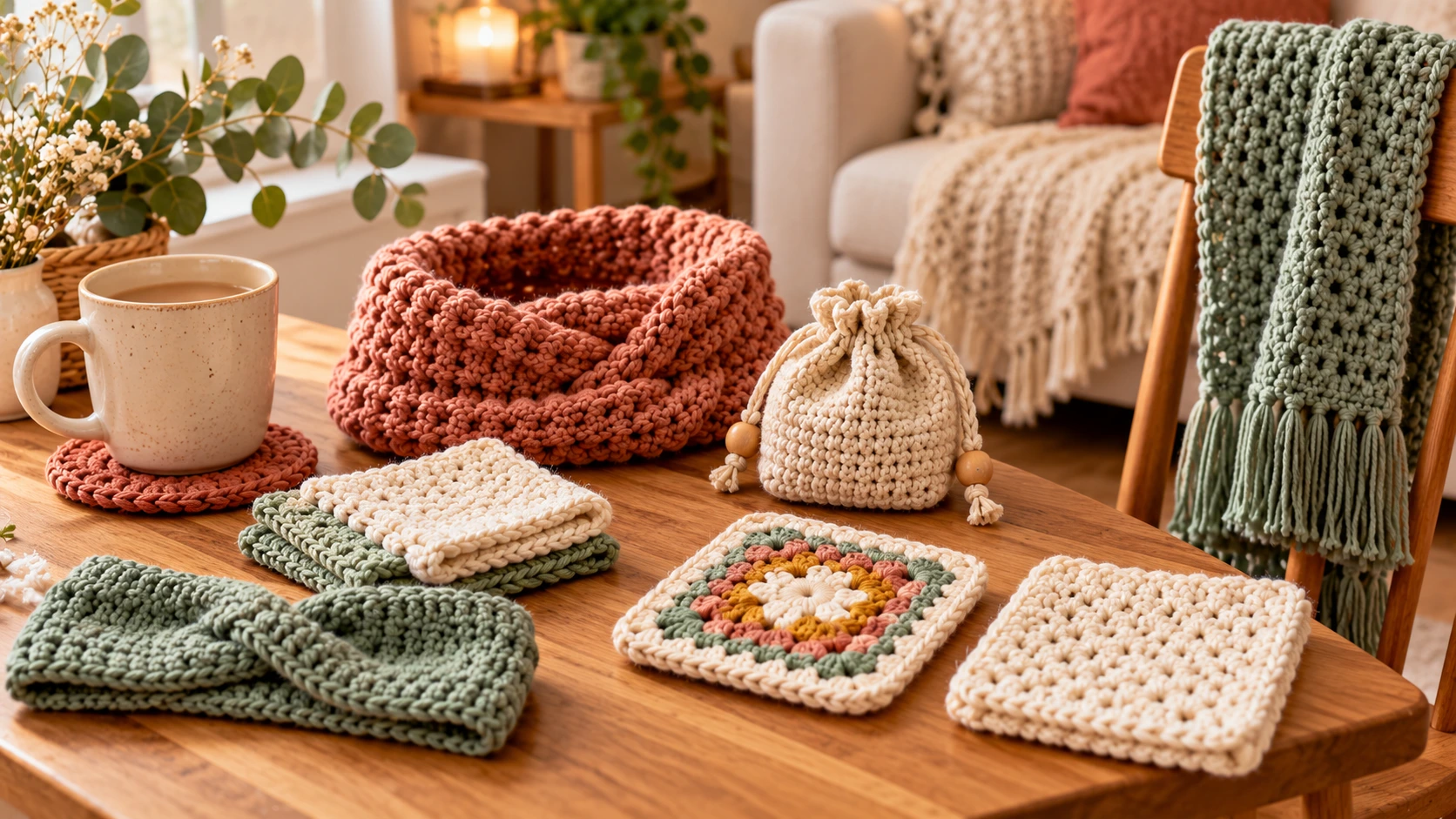
Table of Contents
Starting crochet can feel much easier when your first project is small, practical, and simple enough to finish without a huge time commitment. Instead of jumping straight into a large blanket or complicated garment, a few quick projects can help you learn tension, stitch counting, turning, shaping, joining, and finishing one skill at a time.
This collection of crochet projects for beginners includes 10 original patterns that use familiar stitches and straightforward construction. You will find useful items for the kitchen, home, wardrobe, and everyday life, so you can practice while making something you can actually use.
Most projects rely on basic stitches such as single crochet, half double crochet, and double crochet. Each project includes the materials, approximate sizing, instructions, and adjustment guidance.
Before Starting Your First Crochet Project
You do not need a large collection of supplies.
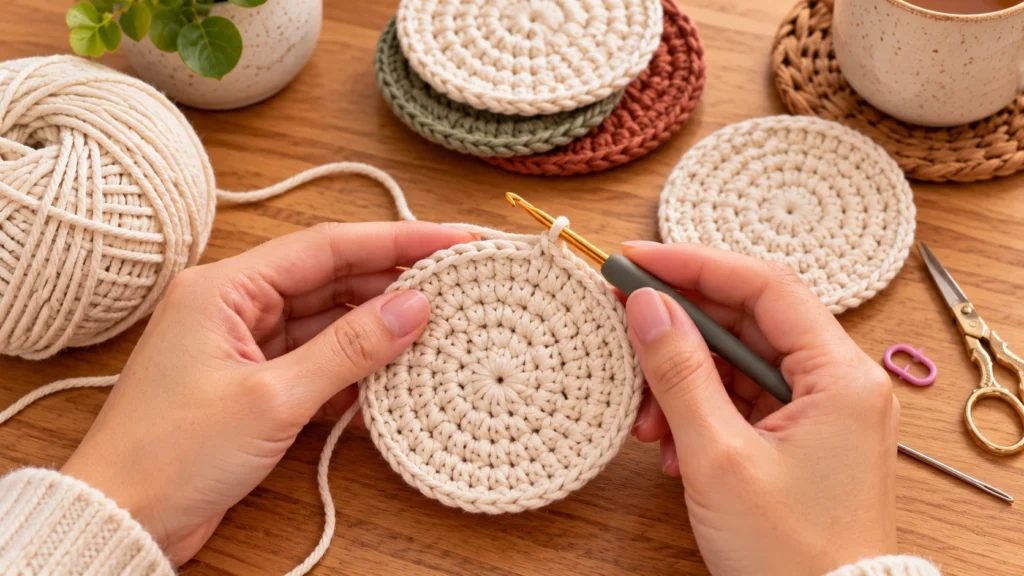
For most beginner projects, start with:
- Medium-weight yarn, usually worsted-weight (#4)
- A crochet hook appropriate for the yarn
- Scissors
- Yarn needle
- Stitch markers for projects worked in rounds
Read the yarn label before choosing your hook. The suggested hook size on the label is a useful starting point, but your personal tension determines the final fabric.
For small projects, gauge may not be critical. For anything that needs a particular size, make a swatch first.
A useful calculation is:
Desired width × stitches per inch = approximate starting stitches
For example, if your gauge is 4 stitches per inch and you want a piece approximately 6 inches wide:
6 × 4 = 24 stitches
The final number may need adjustment for the stitch pattern or repeat.
1. Simple Crochet Coaster
A coaster is one of the easiest crochet projects for beginners because it gives you practice maintaining straight edges without requiring complicated shaping.
It is also small enough that you can finish one quickly and make several more once your tension becomes consistent.
Materials
- Worsted-weight (#4) cotton yarn
- 4.5 mm crochet hook
- Yarn needle
- Scissors
Finished Size
Approximately 4 × 4 inches, depending on gauge.
Stitches Used
- ch
- sc
Pattern
Row 1: Ch 15. Sc in the second ch from the hook and across.
14 sc
Rows 2–14: Ch 1, turn. Sc across.
14 sc
Fasten off.
Weave in the ends securely.
Easy Adjustment
For a larger coaster, increase the foundation chain while keeping the number of rows close to the same as the number of stitches.
For example, a 20-stitch foundation produces a wider starting point.
Beginner Lesson
This project is excellent for learning how to identify the first and last stitch of each row. If your edges begin slanting, check whether you are accidentally skipping the first or last stitch.
2. Basic Crochet Washcloth
A simple washcloth gives you more practice than a coaster while keeping the construction almost identical.
Cotton yarn is particularly practical for this type of project because it creates a useful textured fabric.
Materials
- Worsted-weight (#4) cotton yarn
- 5.0 mm hook
- Scissors
- Yarn needle
Finished Size
Approximately 6 × 6 inches.
Pattern
Foundation: Ch 25.
Row 1: Hdc in the second ch from the hook and across.
24 hdc
Rows 2–24: Ch 1, turn. Hdc across.
24 hdc
Fasten off and weave in the ends.
Optional Border
For a cleaner edge, attach yarn to any corner.
Work sc evenly around all four sides, placing 2 sc in each corner.
Join with a sl st.
Fasten off.
Beginner Lesson
The main skill here is tension. Try not to make the first chain much tighter than the later rows. A loose foundation chain often causes the lower edge to contract.
3. Quick Crochet Bookmark
A bookmark is a useful project when you want something tiny enough to keep in your crochet bag.
It also gives beginners a chance to practice making consistent narrow rows.
Materials
- Worsted-weight or DK yarn
- 3.5–4.0 mm hook
- Yarn needle
- Scissors
Finished Size
Approximately 1 inch wide and 6–8 inches long.
Pattern
Foundation: Ch 8.
Row 1: Sc in the second ch from the hook and across.
7 sc
Rows 2–30: Ch 1, turn. Sc across.
7 sc
Fasten off.
Optional Tassel
Cut several short strands of yarn.
Fold them in half and pull the folded center through the final edge of the bookmark.
Pull the loose ends through the loop and tighten gently.
Trim the ends evenly.
Beginner Lesson
This is a good way to practice turning chains and keeping exactly the same stitch count for multiple rows.
4. Easy Crochet Ear Warmer
An ear warmer introduces beginners to a project where accurate finished measurements matter more than a fixed number of rows.
The piece is crocheted as a rectangle and seamed at the ends.
Materials
- Worsted-weight (#4) yarn
- 5.0 mm hook
- Yarn needle
- Scissors
Finished Size
Approximately 3–4 inches wide.
The circumference should be slightly smaller than the wearer’s head measurement because crochet fabric has some natural stretch.
Pattern
Foundation: Ch 12.
Row 1: Hdc in the second ch from the hook and across.
11 hdc
Row 2 onward: Ch 1, turn. Hdc across.
Continue until the rectangle measures approximately 18–19 inches long for a typical adult starting size.
Measure before seaming rather than relying entirely on row count.
Fasten off.
Assembly
Bring the two short ends together.
Using a yarn needle, sew the ends together securely.
Turn the seam toward the inside.
Size Adjustment
For a smaller headband, stop when the rectangle measures approximately 16–17 inches.
For a larger headband, work until it measures approximately 20 inches.
The actual measurement should be adjusted according to the wearer’s head circumference and the stretch of the fabric.
Beginner Lesson
This project teaches an important crochet habit: measuring your work instead of assuming the pattern will fit everyone exactly.
5. Simple Crochet Mug Cozy
A mug cozy is another useful first project because it introduces measurement-based sizing without complicated shaping.
The cozy should wrap around the mug without covering the handle.
Materials
- Worsted-weight yarn
- 4.5 mm hook
- Yarn needle
- Scissors
Pattern
First, wrap a measuring tape around the widest part of your mug, avoiding the handle.
Subtract approximately ½ inch from that measurement.
Chain until your chain measures approximately that amount.
Row 1
Sc in the second chain from the hook and across.
Rows 2–8
Ch 1, turn.
Sc across.
Fasten off.
Weave in the ends.
Optional Closure
Sew a small button near one short edge.
Create a short chain loop on the opposite edge.
Make sure the button is securely sewn and that the closure is appropriate for the intended use.
Beginner Lesson
This project teaches you how to design around an actual object rather than relying on a universal stitch count.
6. Classic Granny Square
A granny square is one of the most useful building blocks in crochet. Once you understand the basic structure, you can use squares for blankets, bags, pillow covers, garments, and other projects.
Materials
- Worsted-weight (#4) yarn
- 5.0 mm hook
- Yarn needle
- Scissors
Abbreviations
- ch
- sl st
- dc
Round 1
Make a MR.
Ch 3, which counts as the first dc.
Work 2 dc into the ring.
Ch 2.
3 dc into the ring, ch 2.
Repeat from * two more times.
Join with a sl st to the top of the beginning ch-3.
You have 4 granny clusters.
Round 2
Sl st across to the nearest corner space.
Ch 3.
Work 2 dc, ch 2, 3 dc in the same corner.
Ch 1. In the next corner space, work 3 dc, ch 2, 3 dc.
Repeat around.
Join with a sl st.
Round 3
Sl st to the next corner.
Ch 3.
Work 2 dc, ch 2, 3 dc in the same corner.
Ch 1.
3 dc in the next side space.
Ch 1.
3 dc, ch 2, 3 dc in the next corner. Ch 1. 3 dc in the next side space. Ch 1.
Repeat around.
Join with a sl st.
Round 4
Continue the same structure:
- 3 dc, ch 2, 3 dc in each corner
- 3 dc in each side space
- ch 1 between clusters
Join with a sl st.
Fasten off and weave in the ends.
Size Adjustment
Continue adding rounds to make the square larger.
The construction remains the same: corners receive an increase cluster and the side spaces receive regular granny clusters.
Beginner Lesson
This project teaches working in spaces rather than directly into individual stitches, a useful concept for many crochet patterns.
7. Cozy Chunky Crochet Cowl
A simple cowl is a good next step once you are comfortable working in rounds.
Using bulky yarn makes the fabric develop quickly, while a basic stitch keeps the pattern approachable.
Materials
- Bulky (#5) yarn
- 6.5 mm crochet hook
- Yarn needle
- Scissors
Finished Size
Approximately 9–10 inches tall.
For the circumference, measure around the intended wearer’s neck and subtract approximately 1–2 inches depending on the stretch of the fabric.
Foundation
Chain until your foundation measures your desired relaxed circumference.
Join with a sl st, taking care not to twist the chain.
Round 1
Ch 1.
Hdc around.
Join with a sl st.
Rounds 2–12
Ch 1.
Hdc in every stitch around.
Join with a sl st.
Fasten off.
Weave in all ends.
Optional Texture
For a slightly more textured appearance, work each hdc through the back loop only on every second round.
This changes the look of the fabric without requiring a more complicated stitch.
Beginner Lesson
This project teaches you to recognize the difference between working flat and working continuously around a circle.
8. Easy Everyday Crochet Scarf
A simple scarf gives you plenty of repetition, which can actually be helpful while learning crochet.
The repeated double crochet stitch lets you concentrate on consistent tension and clean edges.
Materials
- Worsted-weight (#4) yarn
- 5.0 mm hook
- Yarn needle
- Scissors
Finished Size
Approximately 5–6 inches wide and 55–60 inches long.
Pattern
Foundation: Ch 21.
Row 1
Dc in the fourth chain from the hook and in each chain across.
18 dc
Rows 2–80
Ch 3.
Turn.
Dc across.
18 dc
Fasten off.
Weave in the ends.
Length Adjustment
Continue adding rows until the scarf reaches the length you prefer.
For a shorter scarf, stop earlier.
For a longer scarf, continue working additional rows.
Beginner Lesson
This is one of the best projects for learning consistent turning chains. Try to make each row begin at the same height so the scarf edges stay as straight as possible.
9. Simple Crochet Mini Pouch
A small pouch is a satisfying beginner project because it combines a flat rectangle with basic assembly.
Use it for small craft supplies, earbuds, coins, or other lightweight items.
Materials
- Worsted-weight (#4) yarn
- 4.5 mm hook
- Yarn needle
- Scissors
Finished Size
Approximately 4 × 5 inches before folding and seaming.
Pattern
Foundation: Ch 21.
Row 1
Sc in the second chain from the hook and across.
20 sc
Rows 2–30
Ch 1.
Turn.
Sc across.
20 sc
Fasten off.
Assembly
Fold the rectangle so approximately two-thirds forms the pouch body and the remaining section becomes the flap.
Seam the two side edges using a yarn needle.
Leave the flap open.
Optional Button
Sew a small button to the front of the pouch.
Create a short chain loop at the center of the flap.
Beginner Lesson
This project introduces basic crochet construction: sometimes a useful item does not need shaping at all. A rectangle can become a finished object through folding and seaming.
10. Quick Crochet Face Scrubbie
A small circular scrubbie is a practical way to practice increases and working in rounds.
This project is also useful for learning how regular increases turn a flat circle into a larger shape.
Materials
- Cotton yarn
- 4.0 mm hook
- Yarn needle
- Scissors
Pattern
Round 1
Make a MR.
Work 8 sc into the ring.
Join with a sl st.
8 sts
Round 2
Inc in every stitch around.
16 sts
Round 3
Sc in the next st, inc in the next st.
Repeat around.
24 sts
Round 4
Sc in each of the next 2 sts, inc in the next st.
Repeat around.
32 sts
Fasten off.
Weave in the ends.
Optional Hanging Loop
Join yarn at the edge.
Ch 8.
Sl st back into the same stitch.
Fasten off and weave in the end.
Beginner Lesson
This small circle helps you understand the logic behind amigurumi increases, circular motifs, coasters, bags, and other projects worked from the center outward.
How to Choose Your First Crochet Project
Not every beginner should start with the same type of project.
If you want something extremely quick, choose the bookmark, coaster, or face scrubbie.
If you want to practice straight rows, choose the washcloth, scarf, or mini pouch.
If you want to learn working in rounds, try the granny square or chunky cowl.
If you want to practice measuring for fit, the ear warmer or mug cozy is a useful option.
Starting small is not about avoiding challenging projects forever. It gives you a chance to build muscle memory before taking on more complicated construction.
Beginner Crochet Tips That Make Projects Easier

Count the First and Last Stitch
Beginners often lose stitches at the edges of rows.
At the end of every row, quickly count your stitches.
For example, if the pattern says 20 sc, you should finish with 20 stitches before turning.
Keep Your Turning Chain Consistent
A turning chain that is dramatically tighter or looser than the rest of the row can make the edges uneven.
Try to use the same amount of tension each time.
Do Not Pull Every Stitch Tight
Crochet needs movement.
Pulling the working yarn aggressively after every stitch can make the fabric hard to work and reduce the natural flexibility of the finished item.
Use a Stitch Marker
When working in rounds, place a marker into the first stitch.
Move it after completing each round.
This simple habit makes counting much easier.
Weave in Ends as You Go
You can leave all your yarn ends until the end, but a large pile of tails can make finishing feel much more tedious.
For multicolor or multi-piece projects, weaving in ends periodically can make final assembly easier.
What Should Beginners Crochet First?
There is no single correct first project.
A coaster is excellent for practicing basic stitches.
A washcloth gives you more repetition.
A granny square introduces working into spaces.
An ear warmer teaches measurement and simple assembly.
A scarf gives you lots of practice with the same stitch.
The important thing is to choose something small enough that you can finish it and clearly see how your skills improve.
Caring for Handmade Crochet Projects
Always check the yarn label before washing a finished project.
Cotton and acrylic yarns can have very different care requirements depending on the specific yarn.
Use the recommended water temperature and drying method.
For handmade garments and accessories, reshaping the piece while damp can help restore its intended proportions when appropriate.
Store finished crochet clean and completely dry.
Conclusion
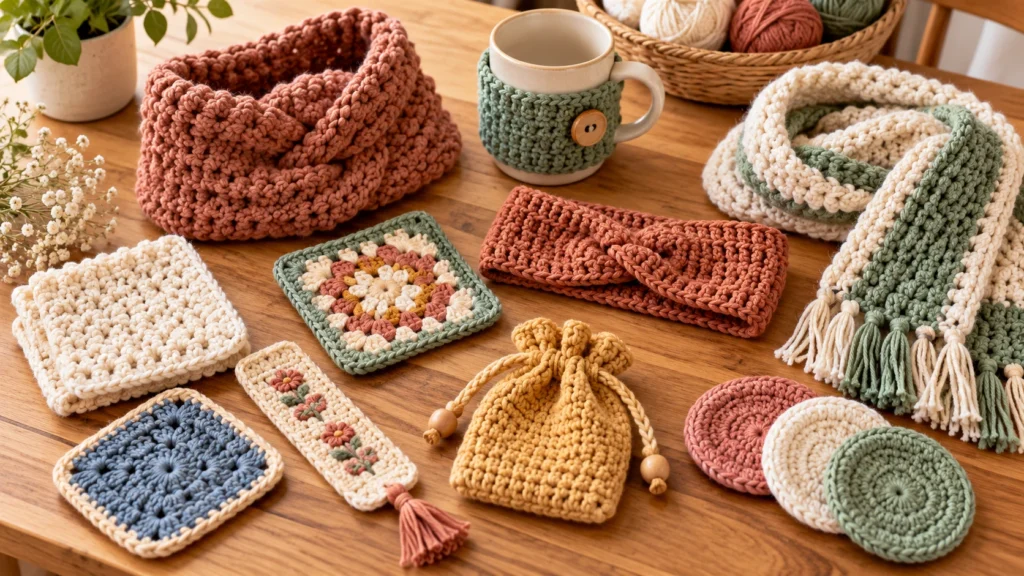
These 10 crochet projects for beginners give you a practical path into crochet without requiring complicated techniques from the start.
You can begin with a coaster or bookmark, move into a washcloth or scarf, and then explore granny squares, simple accessories, and measurement-based projects.
Focus less on making every stitch identical and more on understanding what your stitches are doing. As your tension becomes more consistent, your edges will become neater and your confidence will grow naturally.
The most useful beginner project is often the one you are excited enough to finish. Choose one, gather your yarn and hook, and use the finished piece as your next step toward more advanced crochet.
FAQ
What is the easiest crochet project for a complete beginner?
A coaster, bookmark, or simple washcloth is a good starting point because each uses a small number of basic stitches and does not require complicated shaping.
What crochet stitch should a beginner learn first?
Single crochet is a useful first stitch because it teaches consistent tension and makes it easy to see individual stitches. Half double crochet and double crochet are good next steps.
What yarn is easiest for beginners to crochet?
A smooth worsted-weight (#4) yarn is often a practical starting point because the stitches are relatively easy to see and the yarn is neither extremely thin nor bulky.
Do beginners need to make a gauge swatch?
Not always. Small items such as bookmarks and coasters can tolerate slight gauge differences. Gauge becomes more important for fitted clothing, accessories, or anything that needs specific dimensions.
Why do my crochet edges look uneven?
Uneven edges commonly come from missing the first or last stitch, inconsistent turning chains, or changing tension. Count your stitches regularly and place a stitch marker when working in rounds.
How long does it take to finish a beginner crochet project?
It depends on the project, yarn, stitch, and your experience. Small items such as coasters and scrubbies require much less crocheting than scarves or larger accessories. Focus on learning the technique rather than rushing to finish.