Mosaic Crochet Charts How to Read & Find Free Patterns
Learn how to read mosaic crochet charts, understand symbols, explore overlay and inset techniques, and find free charts for beautiful crochet projects.
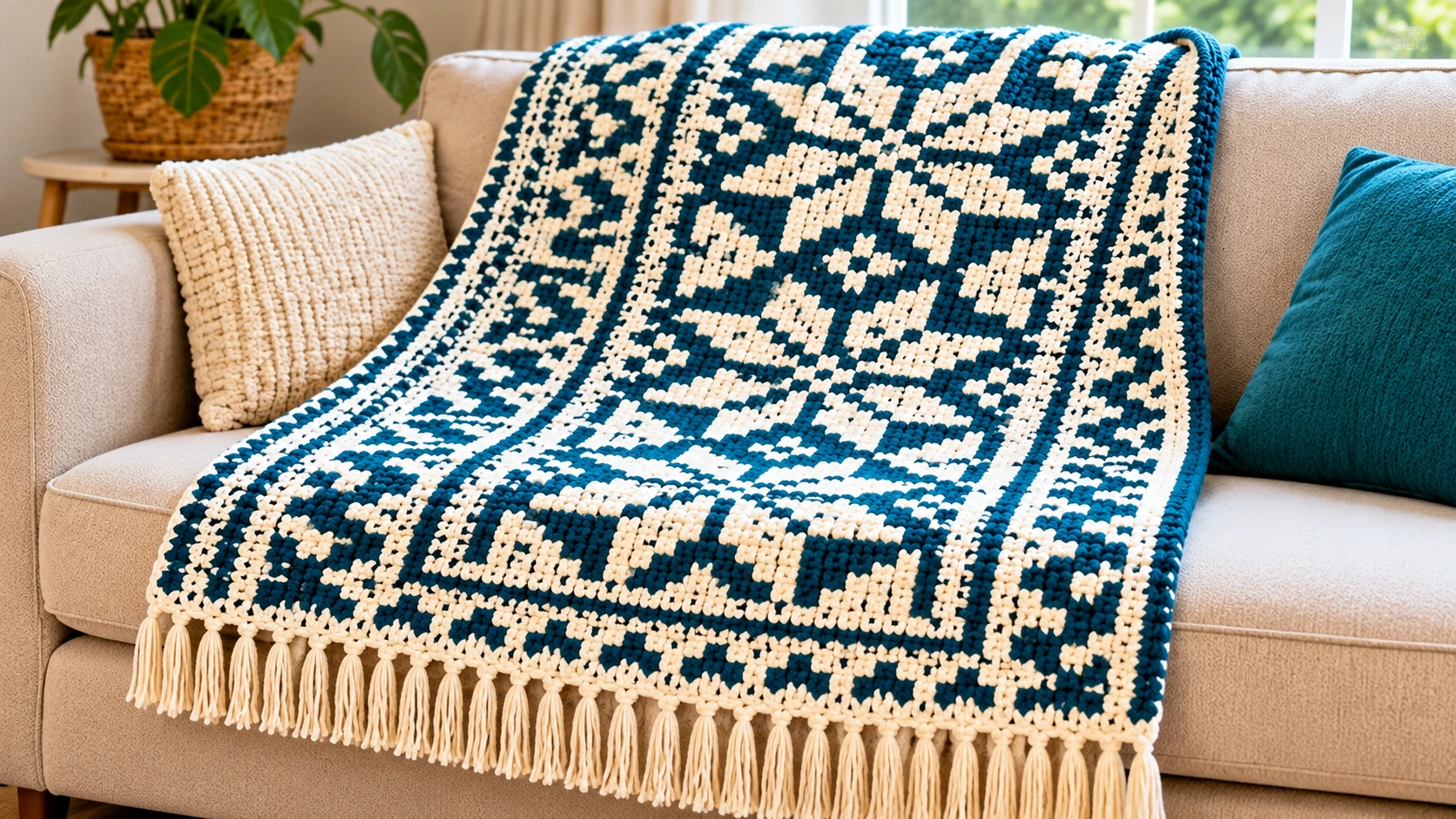
Table of Contents
Have you ever seen a beautiful crochet blanket with stunning geometric shapes, diamonds, flowers, or repeating patterns and wondered how those designs are created? The secret is often mosaic crochet charts!
Mosaic crochet is a creative colorwork technique that allows you to create detailed patterns using contrasting yarn colors and carefully placed stitches. Instead of changing colors several times within one row, you follow a chart that tells you where to place specific stitches to reveal the finished design.
Whether you love modern geometric blankets, decorative pillows, stylish scarves, or beautiful home accessories, mosaic crochet opens up endless creative possibilities.
The best part is that you don’t have to be an expert to get started. Once you understand the chart symbols, row directions, and basic techniques, following a mosaic crochet design becomes much easier.
In this guide, you’ll learn what mosaic crochet charts are, how to read them, the difference between overlay and inset mosaic crochet, where to find free mosaic crochet charts, and how to choose the right designs for your next project.
Let’s explore this beautiful crochet technique!
What Are Mosaic Crochet Charts?
A mosaic crochet chart is a visual grid that shows how to create a decorative crochet design using different colors and stitch placements.
Each square represents a stitch position or instruction, while colors and symbols help you understand how the design develops.
Instead of reading long written instructions for every stitch, you can follow the chart row by row.
Mosaic crochet is particularly popular for creating:
- Geometric crochet blankets.
- Decorative cushion covers.
- Modern table runners.
- Textured scarves.
- Stylish bags.
- Wall hangings.
- Beautiful winter accessories.
Most traditional mosaic crochet designs use two contrasting colors, which help make the geometric shapes and decorative patterns stand out.
Why Use Mosaic Crochet Charts?
Mosaic crochet charts make complicated-looking designs easier to understand and follow.
Here are some advantages of using them:
1. Easy Visual Instructions
You can see the complete design before starting your project.
2. Beautiful Colorwork
Create impressive geometric patterns using contrasting yarn colors.
3. Repeating Designs
Many charts contain a small motif that can be repeated across a larger project.
4. Creative Flexibility
You can change colors, repeat motifs, and adapt designs for different projects.
5. Beginner-Friendly Learning
Once you understand the symbols and chart directions, you can explore many different patterns.
6. Better Project Planning
Charts help you visualize the finished fabric and plan the number of stitches and rows.
Understanding the Two Main Types of Mosaic Crochet Charts
Before choosing a chart, it’s important to understand the two common mosaic crochet techniques: overlay mosaic crochet and inset mosaic crochet.
They create similar visual effects, but their construction and chart-reading methods are different.
1. Overlay Mosaic Crochet Charts
Overlay mosaic crochet is one of the most popular techniques for creating bold geometric patterns.
You normally work one color per row while keeping the right side of the project facing you.
The design is created using regular stitches and longer double crochet stitches that reach down into earlier rows.
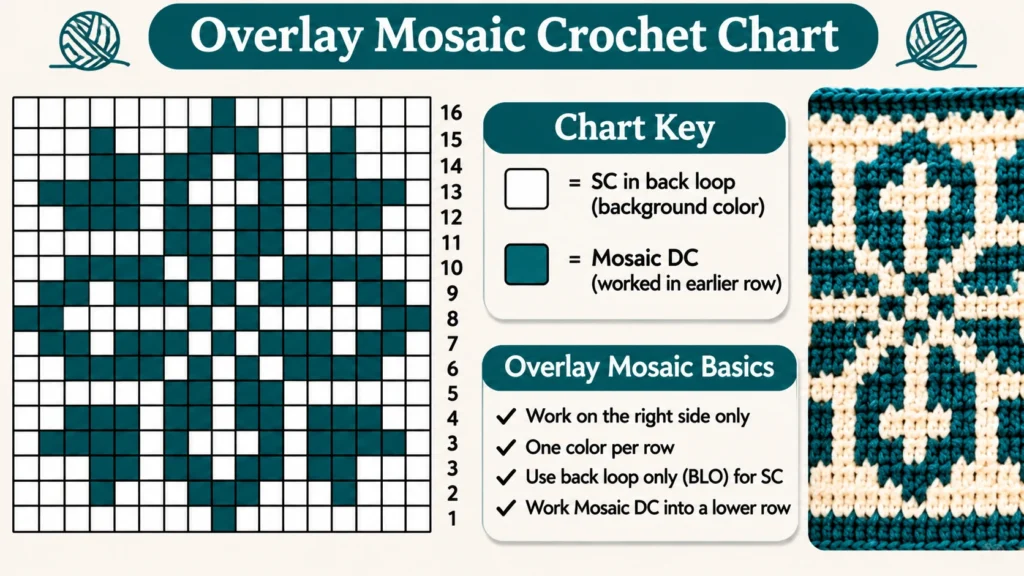
Main characteristics:
- One yarn color per row.
- The work usually stays facing the right side.
- New yarn is commonly joined for each row.
- Back-loop-only single crochet stitches create the background.
- Longer mosaic double crochet stitches create the decorative design.
Common overlay mosaic chart symbols:
- Empty or unmarked square: Usually a regular single crochet in the back loop.
- X or another marked symbol: Usually indicates a mosaic double crochet.
- Colored squares: Help visualize the completed design.
- Row numbers: Show the order in which the rows are worked.
- Color labels: Indicate which yarn to use.
For many standard overlay mosaic crochet charts, right-handed crocheters read each row from right to left. Left-handed crocheters generally read from left to right.
Always check the designer’s chart key because symbols and instructions can vary.
2. Inset Mosaic Crochet Charts
Inset mosaic crochet creates beautiful patterns using a slightly different construction.
Unlike overlay mosaic crochet, inset mosaic is worked back and forth, turning the project after each row.
Many inset mosaic charts compress two crochet rows into one chart row.
These are commonly shown as an A row and a B row.
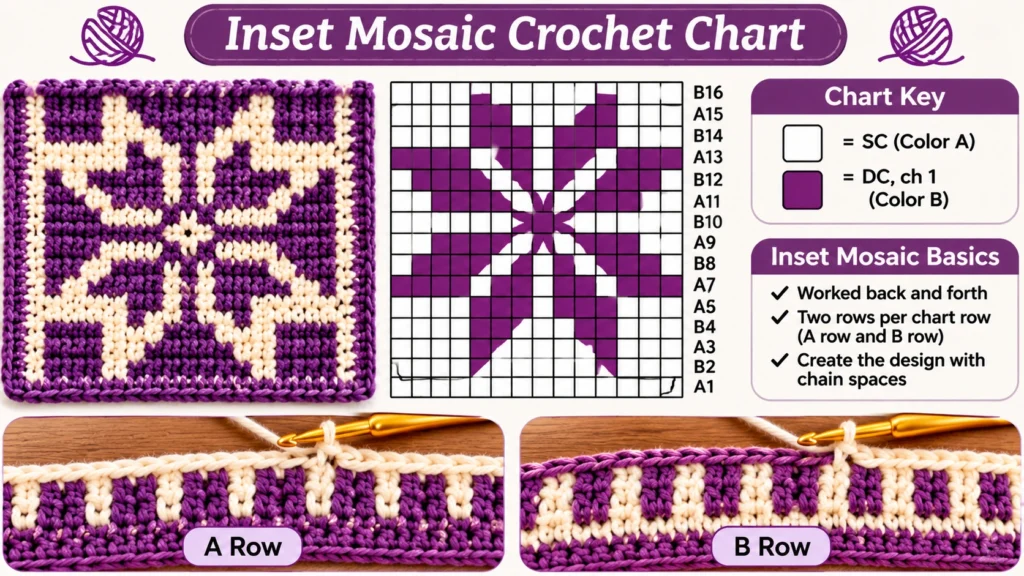
Main characteristics:
- Two rows are worked in the same color.
- The project is turned after each row.
- Chain spaces are used in the design.
- Longer mosaic stitches help create contrasting sections.
- The finished fabric has a different texture from overlay mosaic crochet.
For a typical inset mosaic chart, right-handed crocheters read the A row from right to left and the B row from left to right.
Important: Not every designer uses exactly the same chart layout. Always check the individual pattern instructions before starting.
How to Read Mosaic Crochet Charts Step by Step
At first, mosaic crochet charts may look complicated, especially when they contain many squares, numbers, and symbols.
However, understanding a few basic details makes the process much easier.
Step 1: Check the Chart Legend
The chart legend explains what each symbol means.
Before starting, identify:
- Regular crochet stitches.
- Mosaic double crochet symbols.
- Chain spaces.
- Skipped stitches.
- Yarn colors.
- Special edge stitches.
Never assume that an X or shaded square means the same thing in every pattern.
Step 2: Identify Your Yarn Colors
Most mosaic crochet charts use two contrasting yarn colors.
You might see them labelled:
- Color A: Main background color.
- Color B: Contrasting pattern color.
Choose shades that have enough contrast to make the design easy to see.
For example, cream and dark green create a classic look, while black and white produce a bold geometric effect.
Step 3: Find the Starting Row
Look at the bottom of the chart to identify where the design begins.
Some charts also include foundation rows before the actual mosaic pattern starts.
These rows create the base for the decorative stitches.
Step 4: Follow the Correct Direction
For overlay mosaic crochet, right-handed crocheters usually read from right to left on every row.
For inset mosaic crochet, charts commonly include separate A and B directions.
Always follow the instructions provided with your particular chart.
Step 5: Follow Each Symbol Carefully
Look at each square and check whether it represents a regular stitch, a chain space, a skipped stitch, or a longer mosaic stitch.
In common overlay mosaic patterns, a marked square often indicates where to place a dropped double crochet into an earlier row.
The stitches underneath these longer stitches are handled according to the specific chart instructions.
Step 6: Keep Track of Your Rows
Mosaic designs can contain many repeating rows.
Use a row counter, stitch markers, or a printed chart with a highlighter to keep your place.
This is especially helpful when working on large mosaic crochet blanket charts.
10 Beautiful Mosaic Crochet Chart Design Ideas
Once you understand how charts work, there are many exciting patterns to explore.
Here are 10 design ideas to inspire your next project.
1. Geometric Diamond Mosaic Crochet Chart
Diamond patterns are among the most attractive mosaic crochet designs.
They feature repeated diamond shapes arranged in symmetrical sections.
Design inspiration:
- Large repeating diamonds.
- Alternating small and large diamonds.
- Two-tone geometric patterns.
- Modern diamond borders.
Best projects: Blankets, cushion covers, and wall hangings.
2. Floral Mosaic Crochet Chart
If you love decorative designs, floral mosaic charts are a beautiful option.
They combine geometric sections with flower-inspired shapes.
Design inspiration:
- Repeating flower motifs.
- Four-petal geometric flowers.
- Vintage floral arrangements.
- Symmetrical floral borders.
Best projects: Blankets, decorative pillows, and table runners.
3. Heart Mosaic Crochet Chart
Heart motifs add a romantic touch to handmade crochet projects.
They can be arranged individually or repeated to create a decorative background.
Design inspiration:
- Large central heart.
- Small repeating hearts.
- Double-heart geometric motifs.
- Heart borders.
Best projects: Baby blankets, gift accessories, and cushion covers.
4. Christmas Mosaic Crochet Chart
Christmas-themed mosaic charts are perfect for festive crochet projects.
You can create seasonal decorations using repeating geometric shapes and holiday-inspired motifs.
Design inspiration:
- Christmas trees.
- Snowflakes.
- Reindeer silhouettes.
- Stars and ornaments.
- Decorative Christmas borders.
Best projects: Christmas blankets, stockings, pillow covers, and table runners.
5. Mountain and Nature Mosaic Crochet Chart
Nature-inspired mosaic charts create beautiful decorative designs.
Try exploring mountains, trees, leaves, and landscape-inspired geometric shapes.
Design inspiration:
- Mountain silhouettes.
- Pine trees.
- Forest patterns.
- Repeating leaves.
- Sun and moon designs.
Best projects: Blankets, scarves, and decorative wall pieces.
6. Modern Abstract Mosaic Crochet Chart
For a contemporary appearance, abstract mosaic charts are a wonderful choice.
You can experiment with asymmetrical shapes and repeating lines.
Design inspiration:
- Zigzag patterns.
- Abstract blocks.
- Repeating lines.
- Diagonal shapes.
- Optical-inspired geometric designs.
Best projects: Modern blankets, bags, and cushion covers.
7. Animal-Inspired Mosaic Crochet Chart
Animal patterns can become beautiful crochet designs when simplified into geometric shapes.
Design inspiration:
- Cat silhouettes.
- Owl motifs.
- Fox-inspired geometric shapes.
- Bird patterns.
- Butterfly silhouettes.
Best projects: Baby blankets, decorative cushions, and handmade gifts.
8. Wave Mosaic Crochet Chart
Wave patterns are perfect for creating movement and visual interest.
They combine curved-looking geometric arrangements with repeating stitch patterns.
Design inspiration:
- Ocean-inspired waves.
- Repeating zigzags.
- Layered wave patterns.
- Abstract water-inspired designs.
Best projects: Blankets, scarves, and table runners.
9. Star Mosaic Crochet Chart
Star motifs are especially beautiful for seasonal and decorative projects.
They can create a bold central feature or a repeating all-over design.
Design inspiration:
- Eight-point stars.
- Repeating geometric stars.
- Small star borders.
- Large centered star motifs.
Best projects: Christmas blankets, pillow covers, and decorative throws.
10. Checkerboard Mosaic Crochet Chart
Checkerboard designs are a lovely choice if you enjoy clean geometric patterns.
They can be created using alternating blocks of two contrasting colors.
Design inspiration:
- Large checkerboard squares.
- Small repeating blocks.
- Diagonal checkerboard patterns.
- Two-color decorative borders.
Best projects: Blankets, bags, and home accessories.
Best Yarn and Materials for Mosaic Crochet Projects
Before choosing your favorite mosaic crochet charts, prepare the right supplies.
| Material | Recommendation |
|---|---|
| Yarn | Two contrasting colors |
| Yarn weight | DK or Worsted |
| Crochet hook | Suitable for your yarn |
| Scissors | For finishing yarn |
| Tapestry needle | For weaving ends |
| Stitch markers | Optional |
| Row counter | Helpful for large charts |
| Printed chart | For following the design |
How to Choose the Best Yarn Colors
The right color combination can completely change the appearance of a mosaic crochet design.
Try these combinations:
| Color Combination | Finished Look |
|---|---|
| Cream and Forest Green | Natural and elegant |
| Black and White | Bold and modern |
| Navy and Mustard | Contemporary |
| Sage and Ivory | Soft and minimal |
| Burgundy and Cream | Warm and classic |
| Dusty Pink and Gray | Romantic and subtle |
For your first project, choose two colors that are easy to distinguish.
Where to Find Free Mosaic Crochet Charts
Finding reliable mosaic crochet charts is easier when you explore dedicated crochet designer websites and educational resources.
Here are some useful places to start:
1. HanJan Crochet
A helpful resource for understanding overlay and inset mosaic charts, reading chart symbols, and finding mosaic crochet patterns.
Website: https://www.hanjancrochet.com/mosaic-crochet-chart/
2. The Crochet Architect
Offers an inset mosaic crochet tutorial and free chart resources for practicing the technique.
Tutorial: https://www.youtube.com/watch?v=p12n8m_u7zo
3. Crochet.com
Provides an educational guide to overlay mosaic crochet, including stitch placement, chart colors, and practical examples.
Website: https://www.crochet.com/learning-center/overlay-mosaic-crochet
4. Simply Crochet / Simply Yarn
A detailed guide covering mosaic crochet techniques, chart reading, and ideas for designing your own patterns.
Website: https://simply-yarn.com/guides/how-to-crochet/how-to-do-mosaic-crochet
5. Made Good Designs Mosaic Crochet Pattern Maker
A useful browser-based tool for creating two-color mosaic crochet charts. It offers options for overlay and inset designs and can export charts in PDF, SVG, and PNG formats.
Website: https://madegooddesigns.com/tools/mosaic-crochet-pattern/
Always check the usage terms before downloading, sharing, or republishing a designer’s charts.
How to Create Your Own Mosaic Crochet Charts
Once you’re comfortable reading existing charts, you can start creating your own designs.
You don’t need complicated software to begin.
Here are some useful approaches:
1. Use Graph Paper
Draw a grid and color individual squares to create simple geometric patterns.
Each square represents a stitch position in your design.
2. Use a Digital Grid
A digital grid makes it easier to experiment with different color combinations and symmetrical designs.
3. Start with Simple Shapes
Try diamonds, zigzags, stars, or checkerboard patterns before creating complicated images.
4. Choose Your Technique
Decide whether you want to create an overlay or inset mosaic crochet chart.
The chart must match the stitch construction you intend to use.
5. Add Your Chart Legend
Include the yarn colors, row numbers, symbols, stitch abbreviations, and any necessary edge instructions.
6. Test Your Design
Crochet a small swatch to check that the chart creates the intended result.
Adjust the stitch count or motif placement if necessary.
Common Mistakes When Reading Mosaic Crochet Charts
Even experienced crocheters can make mistakes when following complicated chart designs.
Here are some issues to watch for:
Ignoring the Chart Legend: Always read the symbol key before starting.
Using the Wrong Technique: Overlay and inset mosaic techniques have different construction methods.
Reading in the Wrong Direction: Check whether the chart starts from the bottom right or uses another reading direction.
Forgetting Edge Stitches: Some charts show only the motif and require additional stitches along the edges.
Choosing Similar Yarn Colors: Low contrast can make the design difficult to see.
Skipping Row Counting: Losing track of your place can disrupt repeating motifs.
Ignoring the Designer’s Instructions: Different designers may use slightly different chart symbols and stitch conventions.
FAQ
What are mosaic crochet charts?
Mosaic crochet charts are visual grids that show where to place stitches and colors to create decorative crochet designs.
Are mosaic crochet charts suitable for beginners?
Yes. Beginners can start with simple geometric designs and gradually learn the chart symbols and stitch placement.
What is the difference between overlay and inset mosaic crochet?
Overlay mosaic crochet usually works one color per row without turning the project, while inset mosaic crochet works back and forth, with many charts representing two rows per chart line.
How do you read a mosaic crochet chart?
Start by checking the legend, identifying the yarn colors, finding the first row, and following the chart direction. Read each symbol according to the designer’s instructions.
What do X symbols mean in mosaic crochet charts?
In many overlay mosaic charts, an X represents a mosaic double crochet worked into an earlier row. However, symbols can differ between designers, so always check the chart key.
Can I find free mosaic crochet charts online?
Yes. Several crochet designers and educational websites offer free mosaic crochet charts, tutorials, and practice designs.
What yarn is best for mosaic crochet?
DK and worsted-weight yarn are both popular options. Choose two contrasting colors so the finished design is easy to see.
Can I make a mosaic crochet blanket from a chart?
Absolutely. Mosaic crochet blanket charts can contain repeating motifs, geometric borders, and large decorative designs.
Can I create my own mosaic crochet chart?
Yes. You can use graph paper or a digital mosaic crochet chart maker to create original designs. Always test the chart with a small crochet swatch before starting a large project.
Are overlay mosaic crochet charts different from inset charts?
Yes. They use different stitch-placement rules and chart-reading conventions. Always make sure you know which technique your chosen chart was designed for.
Final Thoughts
Mosaic crochet charts are a wonderful way to explore creative colorwork and make beautiful handmade projects.
From geometric diamonds and floral motifs to Christmas decorations, animal-inspired designs, and modern abstract patterns, there are endless possibilities to discover.
The key to success is understanding the chart symbols, choosing contrasting yarn colors, and following the correct technique for your chosen design.
Start with a simple chart, practice a few rows, and gradually explore more detailed mosaic crochet patterns.
With patience and creativity, you can turn a simple grid into a beautiful crochet design that feels completely your own.
Happy crocheting!